
Driving school Einšteins firmly ranks among the very worst driving schools in Latvia due to a series of manipulative practices that influence consumer choice while ultimately resulting in long training periods and high costs. Its position also reflects the school’s large influence on the market.
Throughout the year the school continuously offered “free theory” promotions — spinning prize wheels, “price of the day”, €1 theory, free theory through the app, etc. For any attentive and experienced observer it is clear that nothing of real value can be obtained for free, and that the attractive wrapping usually comes together with significant costs.
And of course, such practices do not come without consequences. A huge number of disappointed students have flooded social media with loud negative reviews, comments and accusations: scam, rip-off, expensive!!!, endless driving lessons, and so on. There has hardly been a year when Einšteins received so much negativity at once.
The scheme works roughly as follows. The contract requires students to learn theory at a very fast pace while simultaneously starting driving lessons. In practice this means you are forced to learn theory during driving lessons, which is extremely expensive — the promised “free theory” becomes meaningless. Soon the time comes to take the school’s exam while your understanding is still incomplete. Until the end of the year the school also directed students to practice theory exams on the CSDD website, which has already diverged from the real CSDD exam format.
The school’s own theory exam is twice as long and significantly more difficult than in other driving schools. With the existing level of preparation, students may attempt it repeatedly, which creates large additional expenses and consumes considerable time. Naturally students tend to blame themselves for failures, while the problem lies mainly in the system. This system helps maintain high theory exam statistics that can mislead consumers.
Toward the end of the year Einšteins began offering CSN question packages intended for preparing for both the school and CSDD exams (a subscription model). Considering that the school is already expensive and the system problematic, this further increases the overall cost. In effect the school creates a problem and then offers a paid solution.
Incidentally, the distance-learning product for category B is longer than the materials offered by most other driving schools because of repeated explanations of the same content. This raises the question of whether the material could simply be explained more efficiently.
Excessive numbers of driving lessons (which are also among the most expensive on the market) together with repeated exam fees make the school financially inaccessible for many ordinary people.
There is one positive note — refunds from the electronic wallet after finishing studies have become noticeably cheaper.
Einšteins actively promotes its mobile application, again using “free theory” as bait. However, the application does not differ much from the mobile version of the website. Its main usefulness may be for the school itself, as it allows them to easily send notifications to every user — effectively enabling large amounts of marketing messages.
Another surprising element is the contract between the school and the student. It appears extremely one-sided: most obligations fall on the student while most rights remain with the school. If people knew the details beforehand, many would likely refuse to sign it — mainly because of strict deadlines and the costs associated with them. For example, changing the time of a driving lesson may result in a penalty of 10% of the lesson price, even though waiting lists for instructors are already very long. There are nearly twenty ways in which the school may terminate the contract, forcing the student to start the process from the beginning.
At the end of the year a TikTok Advent giveaway campaign initially suggested that participants could win a fully paid driver’s licence. In reality the prize only covered first aid courses, textbooks, 20 academic hours and one exam. Considering the real statistics for driving lessons, this amount would likely cover only about half of the required training. Gifts are welcome, but a large and responsible driving school should avoid misleading the public by suggesting that the legal minimum number of driving lessons is enough to obtain a licence — in practice this often causes conflicts between students and instructors.
In summary, choosing Driving school Einšteins may currently result in significant difficulties and expenses. Unless you enjoy high-risk situations, it may lead to considerable frustration.
Driving school Kristīne is one of the many Latvian driving schools that does not have an electronic system for organizing driving lessons. This means the school essentially sells the client to an instructor — its main source of income (just as driving lessons are the instructor’s main income source). For this reason, Driving school Kristīne has reached 2nd place in our ANTI TOP for having the highest client “transfer” fee in Latvia — €225. The student is not informed that their driving training effectively begins with a negative balance that the instructor will try to recover. As a result, the student should expect a significant number of additional driving lessons.
At present, Driving school Kristīne shares the last place with Driving school Einšteins in terms of the highest potential overpayment for training compared with other driving schools.
There has hardly been a day when Driving school Kristīne has not advertised free theory lessons, particularly on Facebook and Instagram. The school continues to rely on the same old marketing trick that has long been used in the industry.

Driving school Gross is one of the oldest driving schools in Latvia and regularly appears in rankings of the worst schools in the country. This year is no exception, as the school has not abandoned its old tactics.
This year the theory exam results at Driving school Gross have declined significantly over the course of the year, dropping from strong performance to average levels and losing one of its last remaining strong points. In category B driving exams the results still remain at a moderate level, but in category A they are critical — no one (!!) has managed to pass the exams even after repeated attempts.
Gross continues to follow the same traditions it established about ten years ago — pushing “free theory” while recovering the cost through driving lessons. A high initial payment for driving training, the absence of an electronic lesson management system, mandatory attachment to one instructor, the continued use of so-called “introductory” lessons and private payments to instructors are only some of the surprises awaiting consumers.
The key reason why the school ranks 3rd in the list of the worst driving schools in Latvia is the second-highest student “transfer” fee in the country. Students are usually unaware that their driving training at Gross effectively begins at a financial disadvantage — money that the instructor will attempt to recover by prolonging the driving training process without the student even realizing it. According to the Gross contract, the instructor will try to recover €165 from the student before real driving training effectively begins. This is the second-highest fee in Latvia after Driving school Kristīne.
As theory training quality declines, an additional practice has appeared alongside the old habits — theory being taught during driving lessons, which are much more expensive. Considering all these factors, students should expect to take significantly more driving lessons at this school than at many others.
It is also unusual that the price of category B driving lessons after the legally required minimum of 10 lessons is not stated on the school’s website or in the contract. According to the school, this price can only be learned from the selected instructor. This not only indicates a confusing system but also makes it very difficult to estimate the total cost of training in advance.
How can a student be confident that an agreement with the instructor will even be reached and that the training process itself will not be put at risk?
Driving school Gross may continue using such practices, but the impact of our ANTI TOP ranking has already been noticeable — the school has dropped from being the largest driving school in Latvia to only the fifth largest.
Driving school FORS is a small driving school in Riga that ranks 4th in Latvia’s worst driving schools list due to manipulation of driving school rankings and misleading consumers.
The school was founded in 2021 by instructor Konstantīns Gimbickis. In 2023 it created a manipulative driving school ranking website, autoskolas.eu. In 2024 this ranking began to be advertised through Google, making it easily noticeable. After examining this ranking, it became clear within minutes that it had been created by Driving school FORS as a form of direct self-promotion.
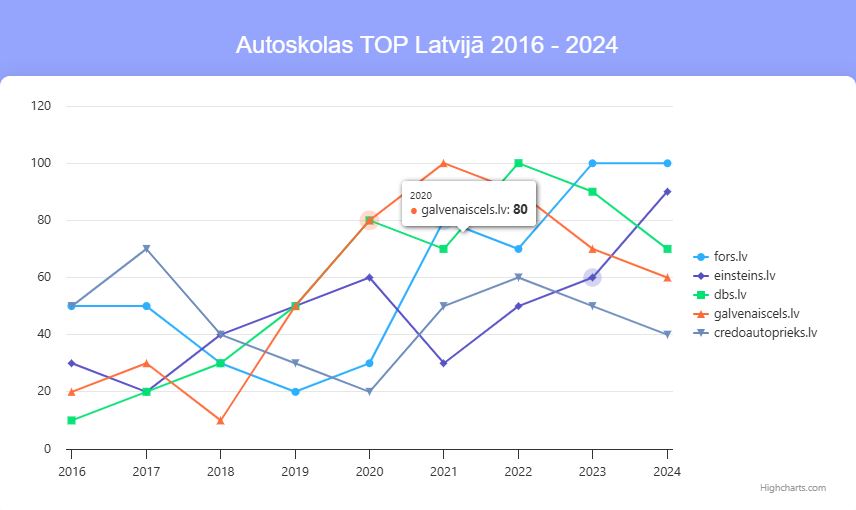
The website autoskolas.eu first appeared online on 20 August 2023, while the domains mentioned in the ranking — fors.lv (16 October 2021) and galvenaiscels.lv (3 December 2021) — appeared later. However, the chart displayed on the website claims that both Driving school FORS and Driving school Galvenais ceļš have been operating since 2016. This is clearly false, as both schools were founded later and their websites appeared relatively recently.
The autoskolas.eu website lists only 10 driving schools, while there are more than 200 driving schools in Latvia. Therefore, it cannot reasonably be described as a national ranking of driving schools.
The website contains entirely fabricated and unexplained numbers as well as fictional ratings. The year has not yet ended, yet the ranking data for the current year is already presented at the beginning of the year, which is illogical. Particular attention should be paid to the “About us” section, where the introduction from our portal autoskolas.com has been copied word for word. This suggests what influenced the creation of this ranking. It should be emphasized that autoskolas.com analyzes and interprets verifiable facts and real events.
It can therefore be concluded that Driving school FORS created this ranking for itself without any real methodology or basis. All information presented in it appears to be fabricated. At present we have not identified any direct connection between the website and Driving school Galvenais ceļš.
The school does not have an electronic driving lesson management system, meaning that students are effectively handed over to instructors. This may make the training process more expensive compared with schools where such systems are used.
If we examine the “best driving schools of the year” statistics according to CSDD data as of 01.12.2024, the results are 58.25% success in theory exams and 27.27% in driving exams, which is significantly below the national average. This clearly indicates weak training results, and therefore we do not recommend this driving school.
The driving exam results are associated with the following instructors: Konstantīns Gimbickis (the founder of the school), Monika Līga Ezermale, Andrejs Sokolovs, Oksana Ruka, Artis Sokolovs, Aivars Apšenieks, Kristīne Jakimenko, Jurijs Kuida, Aivars Kļava, Valērijs Luckis.
One of the purposes of including driving schools in the negative TOP ranking is to discourage unfair commercial practices. Talsu driving school provides consumers with fabricated and defamatory information about competitors over the school’s office phone, even when such information has not been requested — regarding prices, the scale of operations in the city or region, and similar matters.
This is a regrettable practice that reflects the school’s inability to attract clients through fair competition. Consumers may reasonably expect that communication and cooperation with this driving school could also be based on misleading information. Such behavior may significantly affect your expenses or even create obstacles to achieving your goals.
Since the company SIA “SALDUS AUTOSKOLA PLUSS” is registered at the address Lielā iela 6, Talsi — the same address used by Talsu driving school — it may be assumed that this is a branch of Saldus driving school, and the described practice could potentially be associated with it as well. For these reasons, we strongly do not recommend choosing this driving school.
This driving school also lacks an electronic system for organizing driving lessons. As a result, students are effectively handed over to instructors, which may make the training process significantly more expensive compared with driving schools where such systems are used.